People, teams and organisations face difficulties in understanding and coordinating actions every day. Differences in goals, expectations, interests, authority and capabilities can hinder joint activity.
We study mutual understanding, build coordination tools and test their potential in real joint activity.
We invite researchers, developers, organisations and potential partners to take part in developing and testing these approaches.
Theory of mutual understanding; communication and coordination; conflicts of interest; cognitive and social mechanisms of communication; human–AI interaction; experimental methods for testing effectiveness.
Potential value of participation. Jointly defining research questions, designing experiments, analysing data and discussing publications based on agreed results. Publication and co-authorship are not automatic.
Developers and AI specialists
An experimental AI assistant; interviewing and checking understanding; context and sources; models of commitments and dependencies; multi-user interaction; coordination interfaces; assessment of quality, safety and reliability.
Potential value of participation. Work on research prototypes, architecture and experimental technologies with clearly defined limitations that can be tested.
Organizations and teams for pilot studies
Research and educational institutions, work teams, project and civic organisations, and teams with distributed tasks.
Potential value of participation. Studying specific coordination difficulties, assessing clarification of expectations, testing agreement on actions and comparing with existing methods. Pilots require voluntary participation, data protection, safe conditions and appropriate ethical procedures. Effectiveness remains to be tested.
Technology and business partners
Computing and technical infrastructure, software components, organisational support, research funding and joint testing of technological applicability.
Potential value of participation. An opportunity to discuss development directions and a partner’s contribution. Returns, equity, commercial rights and exclusivity are not promised; terms require a separate agreement.
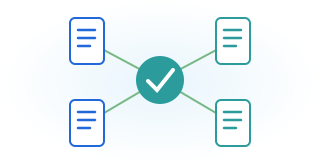
Visual motif of a network of commitments: conditions → possibility of action → result → dependent actions. An explanatory illustration, not a new logo or a guarantee of fulfilment.
What has already been created
Scientific hypothesis
Research foundation
The ObliNet hypothesis and criteria for evaluating benefits have been formulated. The next step is to test the proposed approach experimentally.
A research programme and coordination protocols are available. They define questions and testing procedures; they do not by themselves establish a practical effect.
A local scenario shows dependencies and revision of terms. It does not implement a real network of commitments with confirmation by different users.
Research objective
The method and future AI assistant
Clarifying questions and limitations are set out in the project’s materials. A fully functional AI dialogue system has not been integrated; experimental assessment of the method and implementation of the assistant remain open tasks.
How can we establish that participants understand each other sufficiently for a particular interaction?
B. Experimental AI assistant
How can we select useful clarifying questions, separate facts from hypotheses and help check understanding without pressuring people to agree?
C. Coordinating activity
How can goals, authority, commitments, dependencies and changing conditions be represented in joint work?
D. Experimental testing
How can we measure the approach’s practical value and compare it with existing communication and coordination methods?
E. Safety and responsible use
How can we account for voluntary participation, confidentiality, unequal authority, risks of mistaken conclusions and AI limitations?
Forms of collaboration
These are possible formats to discuss, not existing formal programmes. Tasks, contributions, access to results and participation terms are agreed separately.
Joint research
Define a question, method and assessment criteria. A possible outcome is an agreed research plan and analysis of results.
Software component development
Choose a bounded task, interfaces and testing criteria. A possible outcome is a prototype or a testable component.
Expert review
Review a model, protocol or demonstration. A possible outcome is reasoned feedback and proposals.
Pilot project
Define the context, voluntary participants, data protection and comparison method. A possible outcome is evidence about applicability and limitations.
Providing infrastructure or resources
Discuss needs, access and terms of use. A possible outcome is an agreed contribution to a specific study.
Technology and business partnership
Discuss the parties’ interests, capabilities and constraints. A possible outcome is a decision on further negotiations.
To begin a substantive discussion, use the existing participation page. Your message can include:
Your name or organisation’s name.
Contact email — in the corresponding form field.
Area: scientific research; development and AI; pilot study; technology partnership; resource support; other.
How you could contribute to the project.
What you would like to research, create or test together.
An additional comment, if you wish.
Do not submit trade secrets, confidential information or sensitive personal data. Payment, funding, authorship and intellectual property terms are discussed separately; this page does not promise them.
This page does not collect or send information. The participation page specifies required fields and separate permissions for contact and news. Its notice describes storage in the project’s private database and possible forwarding to the administrator. The external submission handler has not been verified in this build; successful submission is not simulated here. Before submitting, read the privacy terms.